
Searching St. Croix County Civil Dockets
Start at the Wisconsin Court System case-search gateway. Pick Circuit Court, and you land in WCCA. Choose St. Croix County from the list. An exact case number is the fastest path to one file. A party search with a last and first name works too, and businesses go in the business-name field. Once results appear, check the caption, filing date, case class, branch, and status until the match is unmistakable.
- Open WCCA through the state gateway and accept the public-access agreement.
- Set the county to St. Croix and enter the case number exactly as printed.
- If the number is unknown, search a party or business and narrow by date and class.
- Read the header before the event list to confirm that the case matches.
- Use the Civil, Family, small-claims, or probate desk for copies and unresolved access questions.
Remember what WCCA is. It gives a public case summary, not the official judgment and lien docket. An event may show up without its document image. Registered eFiling users see documents only in cases their account can access. Older paper cases may simply have fewer details converted for online viewing.
St. Croix Civil Codes Decoded
Case-type codes sort civil work into broad families. CV marks the ordinary civil class, while SC covers small claims, FA covers family matters, and PR covers probate. A few other categories exist, including protected juvenile classes. The code tells you which desk and rules apply, but the caption and event history are what explain what actually happened in the case.
| Code | Typical matter | Local route |
|---|---|---|
| CV | Contract, tort, property, injunction, or other general civil action | Civil Division, 715-386-4633 |
| SC | Money claim, eviction, replevin, or related small claim | Small Claims, 715-386-4636 |
| FA | Divorce, paternity, placement, or other family case | Family Division, 715-386-4626 |
| PR | Probate and estate administration | Register in Probate route |
Access is not equal across classes. A general CV suit is usually wide open, yet family and probate files can hold protected material. Adoption, guardianship, and juvenile-related records may be absent from WCCA altogether.
Inside a St. Croix Civil Docket
Start with the header. It names St. Croix County. It also gives the case number, class, filing date, branch, status, caption, and judicial officer. Party rows separate plaintiff from defendant, or petitioner from respondent. From there the register runs chronologically. It gives the filing date and title of every pleading, service entry, motion, hearing, order, judgment, lien, or satisfaction. Titles are clues, though, not the full text behind them.
| Caption | The formal case title and indexed party roles. |
|---|---|
| Filing or service | The date and title of a complaint, petition, summons, answer, or service event. |
| Setting | A hearing, motion, trial, commissioner event, date, time, and branch. |
| Order or judgment | The court's ruling or enforceable result; an image may not be public online. |
| Lien or satisfaction | An entry involving judgment docketing or a filing that shows payment or resolution. |
A "Closed" status is not proof a judgment was paid. Read the judgment and satisfaction entries, then ask the Clerk to confirm the official lien index. And never rely on a portal screen where a certified copy is required.
St. Croix Tuesday Money Claims
Money claims are heard in person on Tuesdays. The setting, under the county's January 2025 small-claims procedure, is 1:00 p.m. in Court Commissioner Hearing Room 1. The plaintiff files form SC-500 and states the claim amount. The published filing fee is $94.50, and the plaintiff completes service. The claim amount cannot say "TBD." Those local details set a money claim apart from other small-claims tracks.
Contempt hearings occupy a different Tuesday block. They are listed at 2:30 p.m. in person, using forms SC-507A and SC-507B. Proof of service must be filed at least 24 hours before the hearing. It must show service at least eight business days ahead. The forms themselves carry no filing fee. A sheriff or process server may still charge.
Recurring blocks never override the notice in a specific case. A changed setting shows up in the latest order, event, or court notice. If the docket and the notice conflict, call Small Claims at 715-386-4636.
Civil Case Types on the Docket
A St. Croix County civil docket carries many types. They include an ordinary civil suit, a small claim, a family action, probate, a restraining-order case, a garnishment, or a foreign judgment. Each type brings its own forms, fee structure, and access limits. The Civil Division handles the general civil route. Family and probate have their own desks within the circuit court framework.
Commencement charges run $147.50 for a general civil action seeking $10,000 or less. They rise to $265.50 once the amount exceeds $10,000. A no-dollar restraining-order action is listed at $164.50, and a no-dollar personal-injury or tort action at $265.50. These figures are filing fees only, not copy fees. A given case may add other charges.
A foreign judgment follows a local $20 process. That is $15 to file plus $5 to docket. The filer supplies a certified judgment and an affidavit of identification. Attorneys and high-volume filers must file electronically where required.
St. Croix Civil Copy Choices
The St. Croix County fee schedule draws clear lines among three copy products. A plain copy just reproduces a public file page. Certification adds the Clerk's own authentication to it. Exemplification goes a step further. You should request it only when the receiving office insists.
The county's official fee page shows the current charges. Check it there before sending any payment.
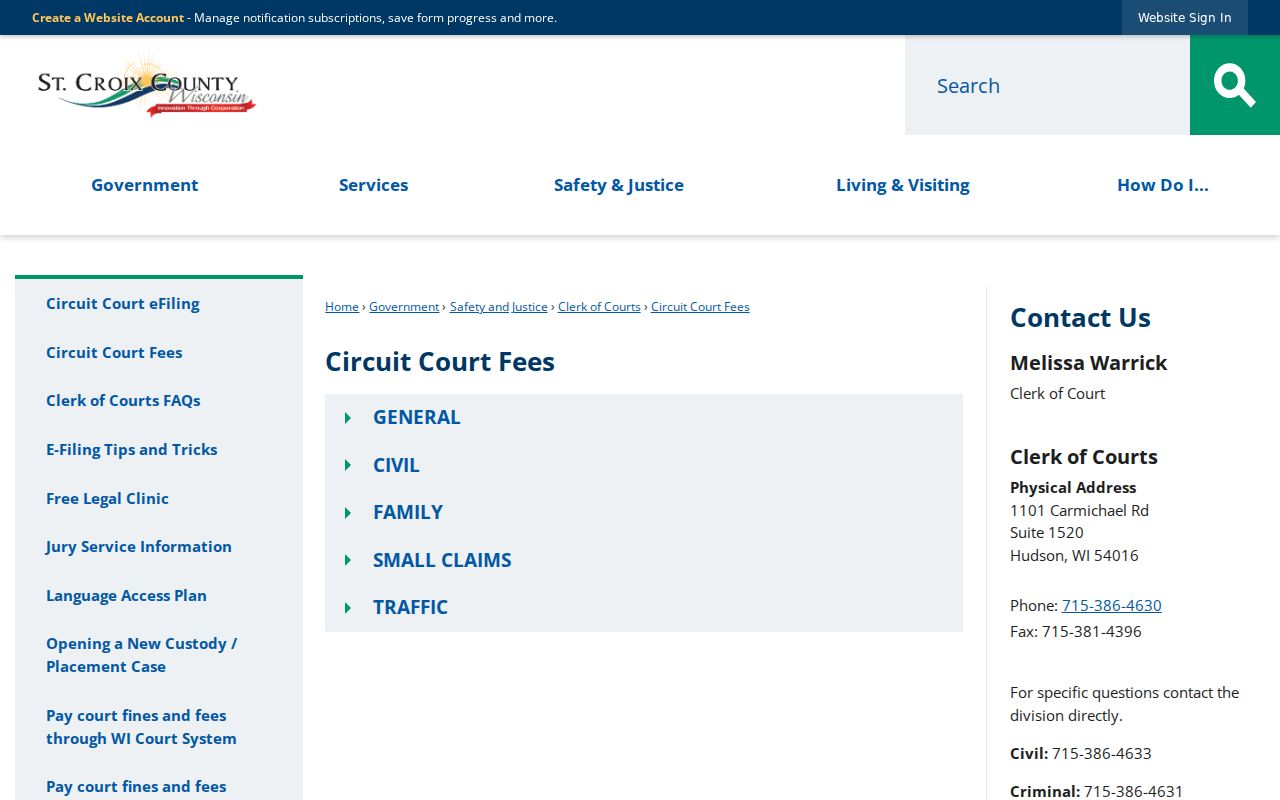
Published rates are $1.25 per copied page, $5 for certification, $15 for exemplification plus copies, and $5 for a name or case-type search. Ask the Clerk for a total before you mail payment.
| Product | Published amount |
|---|---|
| Plain copy | $1.25 per page |
| Certified copy | $5 plus copy charges |
| Exemplified copy | $15 plus copy charges |
| Name or case-type search | $5 |
Civil Docket Settings and Hearings
Read a setting row as a set of facts, not a verdict. Confirm the date, time, event type, branch, judicial officer, and room. Each event type has its own job. A motion asks the court to act. A notice of setting just tells the parties when and where to appear, while a trial, pretrial, commissioner setting, or contempt hearing each moves a St. Croix County case along a different path. None of these entries proves the result.
After a continuance, look at the newest event, because an old setting can sit in the register even after a new date is entered. The county's general public-meetings calendar is no help here. It lists meetings, not cases. A true court date comes from WCCA, the filed notice, or the assigned branch's records.
The 2025 Government Center expansion moved courtrooms and judicial staff into renovated first-floor space at 1101 Carmichael Road, and older pages can still show Suite 1600. Confirm the room before visiting.
Mailing a St. Croix Divorce Request
Mail a written request for a public divorce or paternity copy to the Family Division. Send it to 1101 Carmichael Road, Hudson, WI 54016. Keep it simple but complete. Include the case number, your contact information, the judgment or order you want, a plain or certified choice, and payment. Add a return address too. No case number? List both parties and the year so staff can search.
The county FAQ suggests allowing about two weeks for the mailed route. That's local guidance. It is not a promise for every civil file. Retrieval, review, redaction, and certification work can each add time. Call the Family Division at 715-386-4626 to confirm current instructions. Ask the total due before sending a check or money order.
Older St. Croix Civil Dockets
WCCA itself warns about older cases. Converted or backloaded files can carry less detail than current electronic files. So a sparse St. Croix County civil docket is not the whole story. It doesn't mean no pleading, order, or judgment exists. Note the caption, year, and case class. Then ask the right Clerk division to check the official file.
The gap matters most for judgment research. WCCA is not the official judgment and lien docket. An online status cannot tell you whether a lien was entered or satisfied. The Clerk can name the public record. Staff will also quote the copy, search, or certification charge.
Civil Docket Access Rules
Wisconsin treats court records as public. The presumption covers inspection and copying. Still, judicial rules, confidentiality statutes, sealing orders, and redaction requirements govern civil court records. A retained file is not always open. Family, probate, juvenile, guardianship, adoption, child-protection, and commitment matters need special care. Some categories or documents are restricted.
One statute shapes the request. Under Wis. Stat. §19.35, a request should be specific enough for the custodian to locate the record. Give the case number, caption, division, document name or date, certification, and delivery method. Wisconsin expects a prompt response. No universal local form or guaranteed production time applies to every court file.
Access check: A WCCA absence does not prove expunction or sealing. Ask the Clerk whether the case is restricted, too old for a complete converted summary, indexed under another caption, or held by a different division.
A denial is not the end. The Clerk can explain it and identify the record custodian, but only the court and the governing law can authorize release of a sealed or confidential file.