
Searching St. Croix County Criminal Dockets
One online route covers most of the work. The statewide entry point is Wisconsin's case-search gateway, which routes circuit cases into Wisconsin Circuit Court Access, known as WCCA. Pick St. Croix County first. A full case number is the best search key. If you only have a first and last name, that can still pull up the file. Results may carry felony code CF, misdemeanor code CM, or criminal traffic code CT. Before trusting a match, check the filing date, the caption, the branch, and the case type, since two people can share a name.
- Open the state gateway, choose Circuit Court, and accept WCCA's public terms.
- Select St. Croix County and enter the exact case number when available.
- For a name search, use last and first name, then narrow by type or filing date.
- Open the likely case and compare its header, parties, charges, settings, and events.
- Ask the Clerk for a public filed document or certified copy when the summary is not enough.
Expect some lag. WCCA pulls from the county case-management system roughly hourly while the service runs. Files converted from older systems can be thinner. A document title listed on the docket does not always mean the public image opens. Attorneys and registered parties get authorized documents through Wisconsin circuit eFiling. That account system serves case participants, not the general public. So it is no substitute for WCCA.
St. Croix Criminal Desk Fallback
WCCA came up empty? Call the St. Croix County Clerk of Circuit Court Criminal Division at 715-386-4631. The public counter sits at 1101 Carmichael Road in Hudson. Published hours run 8:00 a.m. to 4:30 p.m. on weekdays. No internet at home? Wisconsin county courthouses provide public-access computers. Have the case number ready. Bring the defendant name, a rough year, and the document title too.
Criminal Division
St. Croix County Clerk of Circuit Court
1101 Carmichael Road, Hudson, WI 54016
715-386-4631
Mailing a records request? Confirm the cost and delivery steps with the Clerk first. Published fees include $1.25 per page. Certification costs $5. A name or case-type search costs $5 as well. A certified judgment of conviction comes from the official clerk file. It does not come from a portal printout. Staff can also point you to the right division for older files. They cannot give legal advice.
Inside a St. Croix Criminal Docket
Read the docket from the top. The header sets out the county, case type, filing date, branch, status, and caption. It also names the assigned judge or commissioner. Each charge row names a count along with its statute or class. Below that, the event register logs filings, hearings, orders, pleas, and results in date order. Money entries may show what is due or paid on the case. But they never stand in for the judgment or sentencing order.
| Case number | A year, type, and sequence such as 2024CF000000; CF, CM, and CT separate major criminal classes. |
|---|---|
| Charge rows | Count, statute or class, plea, and the disposition for that individual charge. |
| Hearing settings | Date, time, branch, event type, and sometimes the judge, commissioner, or room. |
| Event register | Complaint, motion, minutes, order, warrant event, and other dated activity. |
| Disposition | Outcome for the case or count, plus sentence or probation entries when public. |
One label at the top of the case can hide very different outcomes below it. Check each count separately. A charge marked "Dismissed" can sit next to another count with a conviction or some other resolution. A balance shown on the docket is not proof of the whole sentence. And a hearing row only means the event was scheduled, not that it happened.
CF, CM, and CT in St. Croix
Wisconsin's letter codes keep results sorted. CF usually flags a criminal felony, CM a criminal misdemeanor, and CT criminal traffic. The code names the class of file. It says nothing about guilt or the final result. For that, the event history still has to be read.
- Initial appearance
- An early event when the charge is addressed and release conditions may be considered.
- Plea
- The response to a charge, such as guilty, not guilty, or no contest.
- Disposition
- The outcome entered for a count, motion, or whole case.
- Warrant or capias
- A court-process entry requiring attention; it does not state all underlying facts.
Municipal cases run on a separate track. Hudson, New Richmond, River Falls, Glenwood City, and other local courts often handle ordinance matters, traffic tickets, and first-offense OWI. They keep those matters in their own records. A municipal citation will not necessarily show up as a CF, CM, or CT circuit file. If the ticket names a municipal court, ask that city court first.
How a Criminal Case Moves
A St. Croix County criminal case usually opens with a complaint and an initial appearance. From there it may run through arraignment, pretrial events, motions, a plea or trial, judgment, and sentencing. Not every case hits each stage. Some resolve early or in a different order. The docket runs in date order. Because of that, the newest entry is often the best clue to where things stand. Still, check any future hearing row against the latest notice from the court.
Docket flow: Filing → Arraignment → Pretrial → Plea or Trial → Disposition → Sentencing
A jail booking is a different record entirely. The county jail gives the general timing. An initial appearance typically happens at 1:00 p.m. on the next business day after arrest. That timing is only a general rule. It is not a disposition, and it does not confirm the operative court date. For the actual court case, use WCCA or the Criminal Division. Also note that a continuance request sits on the docket as a request until the court grants it.
St. Croix Criminal Treatment Calendar
St. Croix County Treatment Court blends court oversight with treatment and supervision for eligible participants. Status hearings fall on Wednesdays. They start at 8:30 a.m. for this local program. That recurring time slot is helpful context. It never replaces a participant's own docket entry or an official court notice.
The county's own program page is at the link above. It identifies the program itself rather than any private case record.
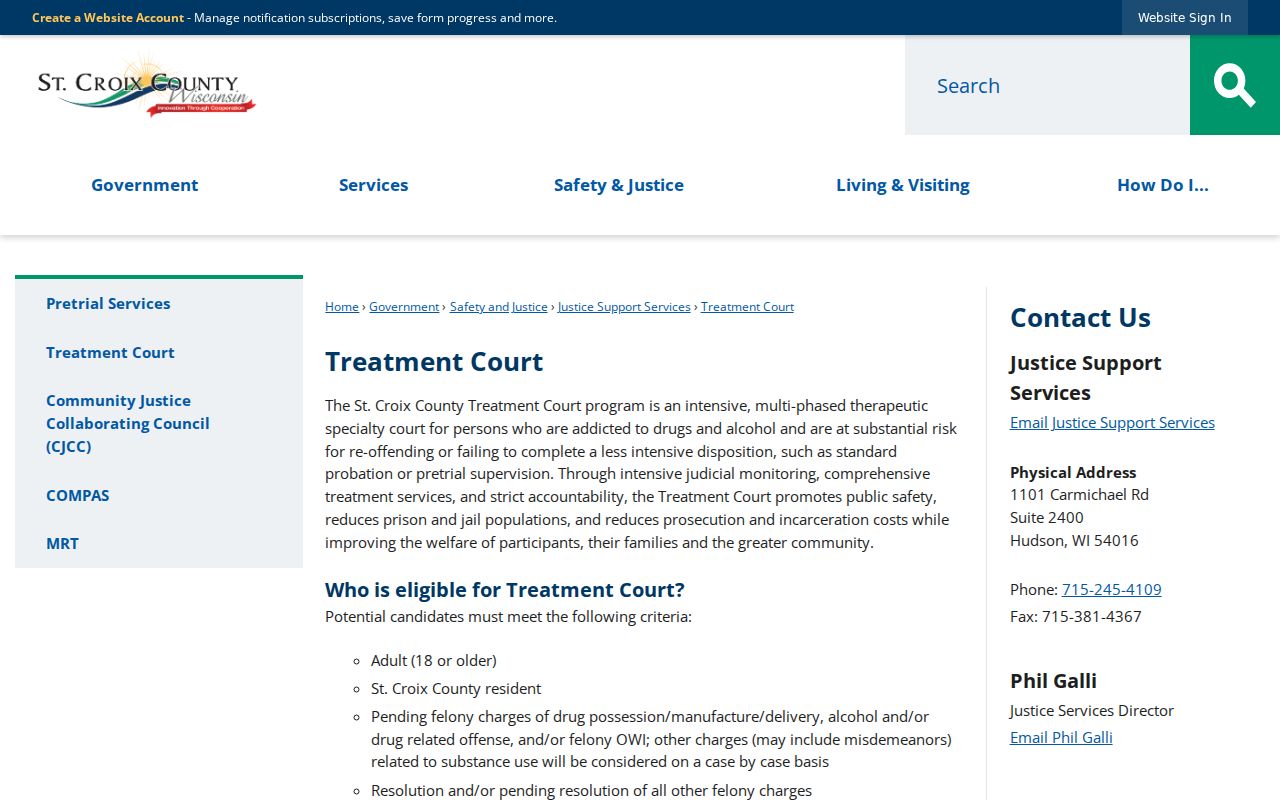
That program page separates a specialty calendar from WCCA's case-by-case register. For a specific status date, confirm with the assigned program or branch. Treatment Court is one calendar inside the Circuit Court system, not a separate search portal.
Courts That Hold Criminal Dockets
St. Croix County Circuit Court is where the county's criminal dockets live. Wisconsin's general trial court runs four branches here, covering felonies, misdemeanors, and criminal-traffic matters. Commissioners handle some preliminary and delegated work. One office, the Clerk of Circuit Court, keeps the record for every branch. There is no standalone criminal courthouse database.
Municipal courts are a different track. They hear ordinance violations, traffic forfeitures, and many first-offense OWI cases, and they keep their own files because they are generally not courts of record. State rules let a qualifying first-offense OWI or PAC defendant ask for a circuit-court jury trial, but the request must come within ten days of the municipal initial appearance. Anything federal stays off WCCA entirely. Those prosecutions sit elsewhere. They belong to the U.S. District Court for the Western District of Wisconsin and the federal PACER system.
St. Croix Warrant Event Limits
A warrant or capias label on the docket means the court entered process. That is all it means. The entry says nothing about the evidence, current enforceability, or later events. Check the entries that follow the issue date for a return, cancellation, vacatur, new appearance, or disposition. Take urgent questions to the Criminal Division or counsel.
Do not infer arrest status from one row. WCCA is a court summary, while jail custody, Wisconsin DOJ criminal history, and Wisconsin DOT driver records are separate systems with different custodians.
The same caution applies to complaint images. When WCCA shows only the title of a criminal complaint, that gap alone does not mean the filing is sealed. The Clerk can tell you whether a public copy exists and what fee or request steps come with it.
St. Croix Criminal Copy Requests
Start a copy request by naming the exact document. The Clerk of Circuit Court needs specifics. Provide the St. Croix County case number, the caption, the division, the document title or event date, and whether you need a plain or certified copy. With those details, staff can pull the right complaint, order, judgment, or sentencing record from the court file. Staff can also flag any access limit.
You may inspect a public court record without justifying why. What you get, and how fast, still depends on retrieval, review, redaction, and certification. The county publishes no universal request form or fixed turnaround, so confirm the method and total cost with the Criminal Division before you mail a payment.
Sealed Dockets and Public Access
Wisconsin presumes that court records are open. That presumption bends to confidentiality laws, sealing orders, redaction rules, and retention rules. WCCA itself lists restricted categories, including adoption, juvenile delinquency, child-protection, termination, guardianship, and civil-commitment records. A criminal case can show a visible public summary. Even so, a restricted document can sit inside it.
Be careful with labels. Sealed, confidential, missing, and dismissed do not mean the same thing. Old records converted into the system may be incomplete. A protected document can be kept on file yet stay out of public view. A dismissal usually stays visible unless a statute or court order says otherwise. If something looks wrong, ask the clerk who entered it. Portal staff cannot rewrite county data.
Key rules:
Wis. Stat. §19.35 provides the general right to inspect and copy records, subject to lawful limits.
SCR Chapter 72 governs retention; retention alone does not make a record public.
Wisconsin court redaction guidance explains protection codes and confidential information in electronic records.